For a Singapore SME, an AI chatbot is a trained assistant on WhatsApp and your website. It answers the routine questions your team repeats every day, takes bookings, and passes the customer to a person the moment the question involves money, a complaint, or a promise. It works at 11 pm on a Sunday and only knows what you teach it. This guide shows how to set one up in four weeks, what it costs, and where the line sits.
Why WhatsApp comes first in Singapore
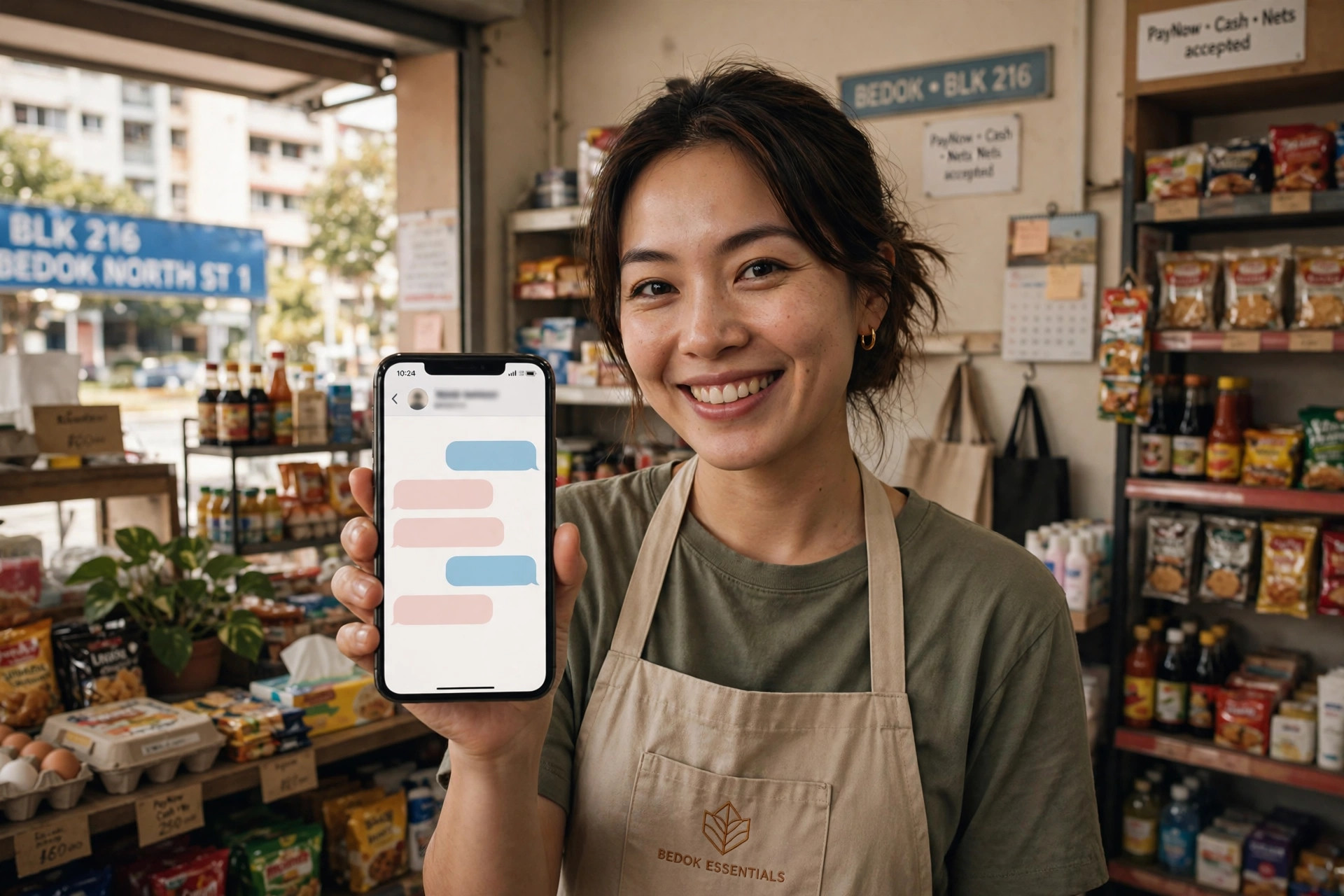
Singapore customers do not start with a contact form. They start with a message. A tuition centre in Tampines or a cafe in Woodlands will tell you the same story: the enquiry arrives while the owner is serving another customer, and by the time someone replies, the person has already asked a competitor.
The timing is good for small businesses. According to IMDA's Singapore Digital Economy Report 2025, AI adoption among Singapore SMEs tripled from 4.2 percent to 14.5 percent in 2024, and customer service was consistently ranked among the top three functions firms automate first. Most competitors have not done this yet, which is the advantage.
What a good chatbot actually does
A useful chatbot does five jobs, and you should judge any option by these five alone.
1. It answers from your own information. The bot is trained on your services, prices, opening hours, and policies, not on general internet knowledge. Change a price in one place and the bot changes with it.
2. It books and qualifies. For appointment businesses, the bot can offer time slots, take a booking, and ask the two or three questions that tell you whether the person is ready to buy this week or just browsing.
3. It speaks the customer's language. Customers write in English, Mandarin, Malay, and Tamil, sometimes in the same conversation. A good bot detects the language and replies in it.
4. It hands over cleanly. A frustrated customer, a refund request, a complaint, or anything involving a promise goes to a person, with the full conversation attached, so the customer never has to repeat themselves.
5. It keeps a record. Every conversation is market research: which questions come up most and what time the enquiries arrive. Review that list monthly.
The app on your phone is not the same as the official platform
The WhatsApp Business app on your phone is free and suits a one person business, but it runs on one phone and its automation is limited to greeting messages and quick replies. The WhatsApp Business Platform, Meta's official API, is what a chatbot connects to. It runs on a number that is not tied to anyone's phone, works across your team, and connects to a booking system.
Meta bills per delivered message by category, and since 1 October 2026 each business number gets 1,000 free service replies a month. Check Meta's own rate card before you budget, because rates change by market and category. Unofficial tools that log into WhatsApp through a phone number may look cheaper, but they risk the number being blocked.
What it costs, honestly
For most SMEs, the honest range is a modest monthly subscription plus message charges. Many platforms start with a free tier, and paid plans for a single outlet commonly sit in the low tens of Singapore dollars a month. Meta's message charges depend on how many conversations you have.
Keep the cost under control two ways. First, start on the free tier and measure for a month before paying. Second, check the grants before you sign. The Productivity Solutions Grant closed to new applications on 29 September 2026, and from 30 September 2026 pre-approved digital solutions are funded under Enterprise Singapore's EDGE Grant, which supports up to 50 percent of qualifying costs for SMEs, within a S$30,000 annual sub-cap. Confirm the current position on GoBusiness before committing.
A four week setup plan
Week one: list the questions. Write down the ten questions your team answers most often, with the correct answers. Ask your staff: they know the real list.
Week two: pick one channel and one job. Start on WhatsApp only, answering enquiries. Set the handover rules in writing: which topics go to a person, and who picks them up.
Week three: test with real customers, quietly. Turn the bot on and read every conversation for a week. Fix the wrong answers and add the questions you missed. This week is the whole project.
Week four: measure and decide. Count three numbers: enquiries the bot answered alone, handovers, and after-hours bookings. If the bot handled most routine questions and the handovers were smooth, keep it and add the next job, such as reminders. If it struggled, fix the answers first.
What never to hand to a chatbot
The Personal Data Protection Commission issued Advisory Guidelines on Use of Personal Data in AI on 20 July 2026, and IMDA's Model AI Governance Framework for Agentic AI (version 1.5, May 2026) makes the same point: accountability stays with the business, even when an agent does the work. Do not paste customer names, phone numbers, or order details into a public AI tool. Tell customers when they are talking to an AI assistant. Never let the bot answer a complaint, handle a refund, or speak for your business in a dispute.
What it does is make sure the customer who messages at 10 pm gets an answer, instead of silence.
— The core principle of AI chatbots for small businesses
Frequently Asked Questions
How much does an AI chatbot cost for a small business in Singapore?
A basic setup usually costs a modest monthly subscription plus Meta's per-message charges, and many platforms offer a free tier for low volumes. Since 1 October 2026, each business number gets 1,000 free service replies a month, which covers most small shops entirely. Start on a free tier, measure one month of conversations, and only then choose a paid plan. Check the EDGE Grant position on GoBusiness before you pay.
Is a WhatsApp chatbot legal for a Singapore SME?
Yes, provided you follow the PDPA. Do not feed customer personal data into tools that use it for training, tell customers they are talking to an AI assistant, and keep a person in charge of anything involving money or promises.
Will a chatbot replace my staff?
No. A chatbot replaces the repetitive part of the job, which is answering the same ten questions all day. It does not replace the person who handles a complaint, closes a sale, or decides what to do when something goes wrong.
Can a chatbot take bookings and deposits?
Yes, if it is connected to the official WhatsApp Business Platform and your booking system. Appointment businesses commonly use the bot to offer slots, confirm bookings, and send reminders. Taking a deposit needs a payment link and a clear refund policy.
What happens if the chatbot gives a wrong answer?
It will, at least once, which is why week three of the setup plan is reading every conversation. Fix the answer in the bot's knowledge, not in the chat. If a wrong answer reaches a customer, a person should follow up quickly and correct it.
A chatbot will not make your business worth choosing. Knowing your customers by name and keeping your promises will. What it does is make sure the customer who messages at 10 pm gets an answer, instead of silence. Start with the ten questions, keep a person in charge, and let the results decide what comes next. If you want help setting it up, our team builds AI marketing and chatbot services for Singapore businesses.

Sources
- IMDA, Singapore Digital Economy Report 2025 (SME AI adoption tripled from 4.2 percent to 14.5 percent in 2024; customer service among the top three functions automated first), as reported at https://aiinasia.com/guides/whatsapp-ai-chatbots-southeast-asia-smes
- PDPC, Advisory Guidelines on Use of Personal Data in AI, 20 July 2026
- IMDA, Model AI Governance Framework for Agentic AI, version 1.5, May 2026
- Meta WhatsApp Business Platform pricing (per-message billing since 1 July 2025; 1,000 free service messages per number per month since 1 October 2026), as reported at https://www.chatbridge24.com/whatsapp-business-api/pricing
- Enterprise Singapore EDGE Grant (Productivity Solutions Grant closed to new applications 29 September 2026; pre-approved digital solutions funded under EDGE from 30 September 2026, up to 50 percent for SMEs, S$30,000 annual sub-cap), as reported at https://rafflescorporateservices.com/smes-go-digital-2026-grants-pre-approved-solutions/