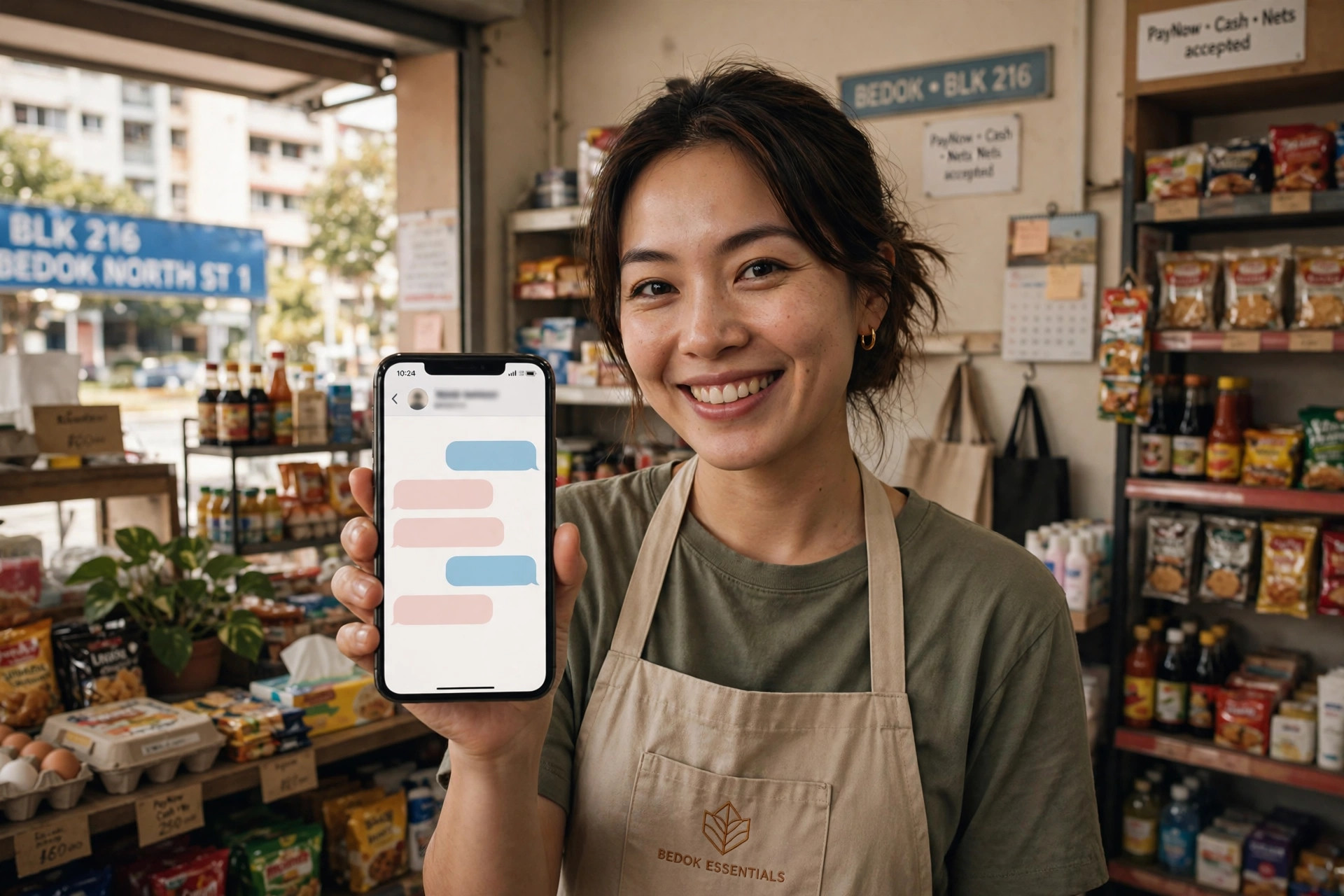
For a Singapore SME, AI marketing means using AI tools for four specific jobs: drafting content faster, answering customer enquiries around the clock, targeting ads more precisely, and reading campaign data in plain language. A person stays in charge of prices, promises, and customer data. Start with one job, measure the result for a month, then expand. The rest of this guide shows you how to run it without wasting money or breaking the rules.

Why 2026 is the year to start
AI adoption among Singapore SMEs is still early, which is exactly why the advantage is real. According to IMDA's Singapore Digital Economy Report 2026, SME adoption of AI rose from 14.5 percent in 2024 to 23.4 percent in 2025. That means roughly three in four SMEs have not started yet. DBS found a similar mood in its 2025 Business Pulse Check Survey: 73 percent of respondents planned to invest in generative AI powered solutions, while 32 percent had already started experimenting with generative AI tools for functions such as marketing and communications.
The gap between planning and doing is where a small business wins. A tuition centre in Tampines, a florist in Jurong East, or a cafe in Orchard does not need an enterprise budget: most useful tools have free tiers, and grants help pay for the rest. The businesses that benefit are not the ones buying every new tool. They point AI at one clear, repetitive job and check whether it saves time or brings in enquiries.
The four jobs AI does well
Think of AI marketing as four jobs, not one big system.
1. Drafting content. AI writes first drafts of social media captions, product descriptions, email newsletters, and blog outlines in minutes. A human then edits for accuracy, tone, and local detail. Florist Far East Flora reportedly cut content production time by around 50 percent after adopting generative AI tools for marketing and sales content, according to coverage of the refreshed Retail Industry Digital Plan. Drafting is the safest place to start because a person reviews everything before it goes out.
2. Answering customer enquiries. An AI assistant on your website or WhatsApp can answer common questions at any hour: opening times, prices, delivery areas, and booking links. It should hand over to a person the moment a question involves a promise, a complaint, or money.
3. Targeting ads. Google Performance Max and Meta Advantage use AI to test ad combinations and find audiences a small team would never reach by hand. You set the budget, the location, and the goal, such as enquiries or store visits, and the system does the testing. Check results weekly and stop any ad set that spends without producing enquiries.
4. Reading campaign data. AI features in Google Analytics 4 flag unusual changes, such as a sudden drop in enquiries from a campaign, and explain them in plain language. For an owner without a data team, that turns a confusing dashboard into a short list of things to fix.
A five step plan for the next 30 days
Step 1: pick one job. Choose the task that eats the most of your time each week. For most SMEs it is content drafting or replying to enquiries. Write down how long it takes now, so you can compare honestly in a month.
Step 2: choose one tool per job. Start with tools that have free tiers: ChatGPT or Claude for drafting, Canva for visuals, and a chatbot for enquiries. Keep a short list of what each tool is allowed to do and what it must never do, such as quoting a price or promising a delivery date.
Step 3: set the guardrails before you publish anything. Singapore's rules are clear and practical. The Personal Data Protection Commission issued Advisory Guidelines on Use of Personal Data in Generative AI on 20 July 2026, which explain how the PDPA applies when customer data flows through AI systems. The practical rules for an SME are simple: do not paste customer names, phone numbers, or order details into a public AI tool; tell customers when they are talking to an AI assistant; and keep a human review step before anything is sent or published. IMDA's Model AI Governance Framework for Agentic AI, version 1.5 from May 2026, makes the same point in different words: accountability stays with the business, even when an agent does the work.
Step 4: measure one number. Pick the number that matters for the job you chose: hours saved per week, enquiries answered after hours, or cost per enquiry from ads. Record it weekly in a simple sheet. If the number does not move in a month, change the workflow or drop the tool. Our earlier guides on SEO for Singapore SMEs and getting cited in AI answers use the same discipline: visibility only counts when it turns into enquiries.
Step 5: check the grants before you pay. The Productivity Solutions Grant supports selected digital solutions, including some AI powered marketing and customer service tools, and eligible SMEs may receive up to 50 percent support depending on the approved vendor and package. The Enterprise Development Grant covers larger projects. Check the current catalogue on the SMEs Go Digital platform or GoBusiness before you subscribe to anything, because eligibility and approved packages change.

What to never hand to AI
Some jobs stay human, no matter how good the tools get. Never let AI write a price, a discount, or a delivery promise without a person checking it. Never let it answer a complaint, handle a refund, or speak for your business in a dispute. Never feed it customer lists, contracts, or anything covered by the PDPA without checking what the tool does with that data. And never publish AI output that mentions a fact you have not verified: a wrong opening hour or a wrong price on your own website damages trust faster than any tool can rebuild it.
What it costs, honestly
A sensible starting setup costs little. Free tiers cover drafting, basic visuals, and simple chatbots. Paid plans for the main writing and design tools sit roughly in the range of S$25 to S$55 per user per month. Add a modest ad budget only after the organic workflow works, and only for campaigns you can track to enquiries. The real cost is the hour a week you spend reviewing output, fixing mistakes, and teaching the tool how your business actually speaks. Budget that hour like money: it is the difference between AI marketing that sounds like you and marketing that sounds like everyone else.
Your 30 day starter checklist
Week one: pick one job, write down the time it takes now, and choose one free tool. Week two: draft five pieces of content or set up five standard replies, and review each one before it goes out. Week three: turn on the measurement, whether that is hours saved, enquiries answered, or cost per enquiry. Week four: decide what to keep, what to fix, and what to stop, then check whether a grant covers the next tool on your list. If the first month saves you even three hours a week and brings in a few extra enquiries, the habit is worth keeping. If it does not, you have spent almost nothing to find out.
AI marketing will not replace the things that make a Singapore SME worth choosing: knowing your customers by name, keeping your promises, and showing up in your neighbourhood. It simply gives a small team the speed of a bigger one. Start with one job, keep a human in charge, and let the results decide what comes next. If you want help setting up that first workflow, our team builds AI marketing and SEO services for Singapore businesses.
AI marketing will not replace the things that make a Singapore SME worth choosing: knowing your customers by name, keeping your promises, and showing up in your neighbourhood.
— The core principle of AI marketing for small businesses

Sources
- IMDA, Singapore Digital Economy Report 2026 (SME AI adoption 14.5 percent in 2024 to 23.4 percent in 2025)
- DBS, 2025 Business Pulse Check Survey (73 percent plan to invest in generative AI, 32 percent already experimenting)
- Marketing-Interactive, "Singapore refreshes retail digital plan to boost AI adoption among SMEs" (Far East Flora content production time cut of around 50 percent): https://www.marketing-interactive.com/singapore-refreshes-retail-digital-plan-to-boost-ai-adoption-among-smes
- PDPC, Advisory Guidelines on Use of Personal Data in Generative AI, 20 July 2026, as reported at https://www.computerweekly.com/news/366645910/Singapore-spells-out-how-personal-data-can-be-used-in-GenAI
- IMDA, Model AI Governance Framework for Agentic AI, version 1.5, May 2026, as reported at https://www.jdsupra.com/legalnews/singapore-ai-guidance-governance-data-7830610/
- Productivity Solutions Grant, support of up to 50 percent for approved solutions